
Building a data platform for neoclouds comes down to a short list of engineering decisions forced by one structural fact: the GPU fleet is provisioned and billed for synchronized training runs, while the work of getting data ready for those runs, ingest, cleaning, joins, dedup, feature and embedding generation, eval-set construction, is CPU-heavy, shuffle-heavy and runs continuously in the gaps. Each decision below, from CPU pools to pricing, follows from that mismatch.
The landscape a builder is choosing from splits by what gets federated and what gets run. Managed lakehouse and warehouse platforms own catalog, compute and governance together. Query federation engines sit across existing sources without owning the data. Hyperscaler-managed Spark services bundle a control plane around open-source engines. Embedded execution layers install inside an existing environment and run jobs against catalogs that already exist. Each fits a different piece of the estate.
What a Data Platform for Neoclouds Has to Do
A platform built for this purpose has a narrow job: move raw data in, clean and join and deduplicate it, generate features and embeddings, assemble evaluation sets, and write the result back out in an open table format that training jobs and downstream tools can read. It does not need to be a BI tool or a second system of record; a duplicated catalog just creates two places the same table can drift out of sync. That smaller scope is what makes a data platform for neoclouds buildable on a fleet whose economics were never designed around it.
CPU Capacity Next to the GPUs in GPU Cloud Computing
CPU capacity next to the GPUs is the first constraint most teams underestimate in gpu cloud computing, because the CPUs on a training node are already busy feeding batches to the GPU, running collective-communication overhead and handling checkpoint I/O. A Spark join running on those same cores competes directly with the job the node exists for. A separate CPU pool, sized for data prep and living in the same region and storage network as the GPU fleet, keeps the two from fighting over cycles at all.
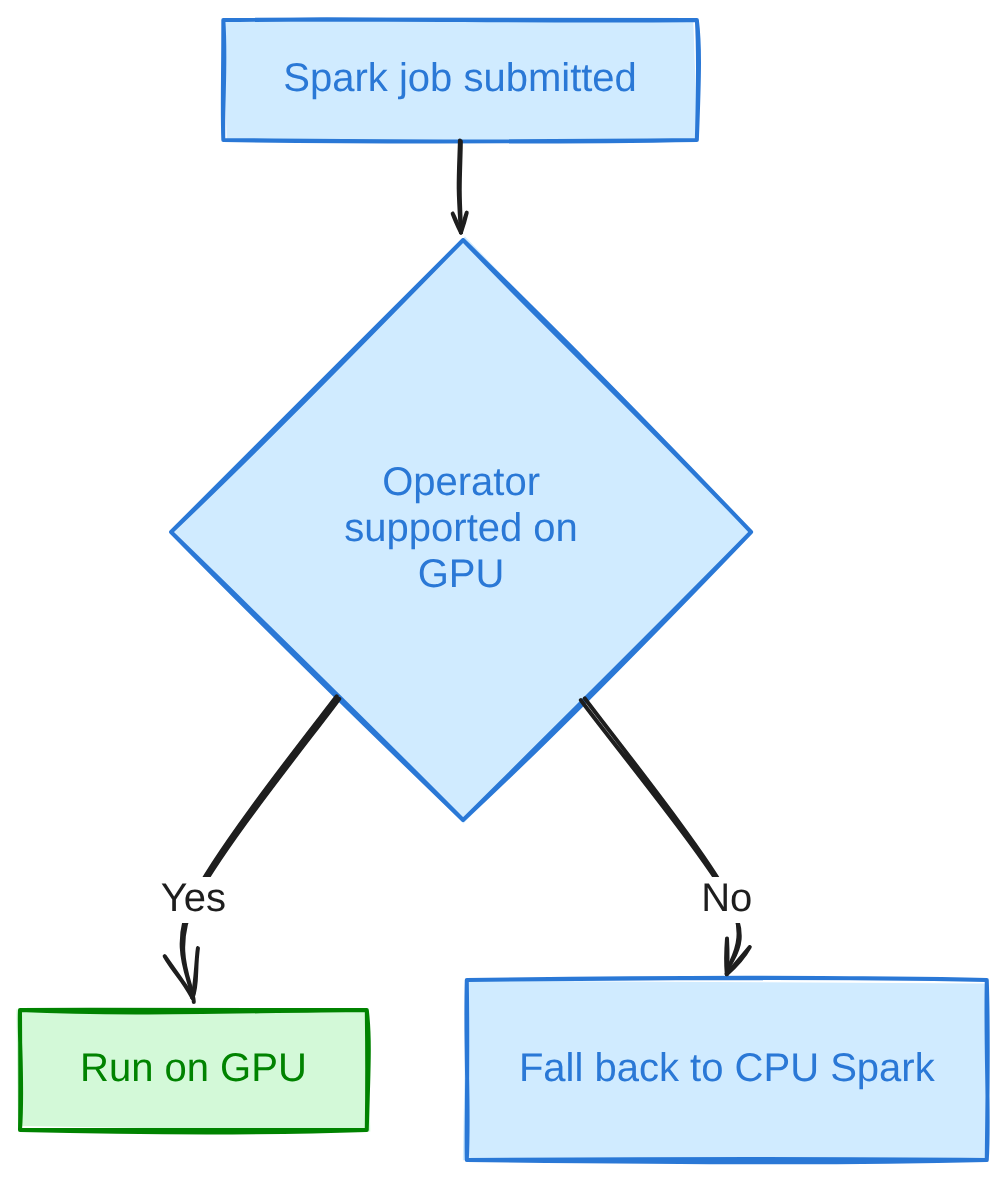
Some of that work can move to the GPU instead. NVIDIA’s RAPIDS Accelerator for Apache Spark runs supported SQL operators on GPU and falls back to ordinary CPU Spark for anything unsupported, UDFs included, with no code change required. The plugin is version-pinned to specific Spark and runtime combinations, so check NVIDIA’s support matrix before assuming it runs on any cluster.
# Enable GPU execution; unsupported ops/UDFs fall back to CPU automatically
spark.plugins=com.nvidia.spark.SQLPlugin
spark.rapids.sql.enabled=true
spark.rapids.memory.pinnedPool.size=2G
spark.task.resource.gpu.amount=1
spark.executor.resource.gpu.amount=1
NVIDIA recommends a workload-qualification pass before converting a production job, rather than assuming full coverage. The result worth building for is a job that runs against CPU or GPU depending on which capacity is free, since GPU-minutes are too expensive to leave idle and too contested to let data prep hog.
Storage Tiers for Data Prep on a GPU Fleet
Storage in a data platform for neoclouds separates cleanly into three tiers by how long data needs to live and how many jobs touch it.
| Tier | What lives there | Treat it as |
|---|---|---|
| Object storage, open table format (Iceberg, Delta) | Raw landing zone, cleaned tables, feature tables, eval sets | The durable system of record every job reads from and writes back to |
| Shared file or block storage | Small mutable sets: config, checkpoints, lookup tables | Convenient, not the place for the main dataset |
| Local NVMe on the node | Shuffle files, spill, disk cache | Ephemeral; gone when the node recycles |
Writing results back in Iceberg or Delta rather than a proprietary format keeps the output usable by whatever reads it next, a training job on a different cluster, a notebook, an eval harness. Treating local NVMe as anything other than ephemeral is a common and avoidable way to lose a day’s shuffle output to a spot reclaim.
Catalog Federation Beats Catalog Migration
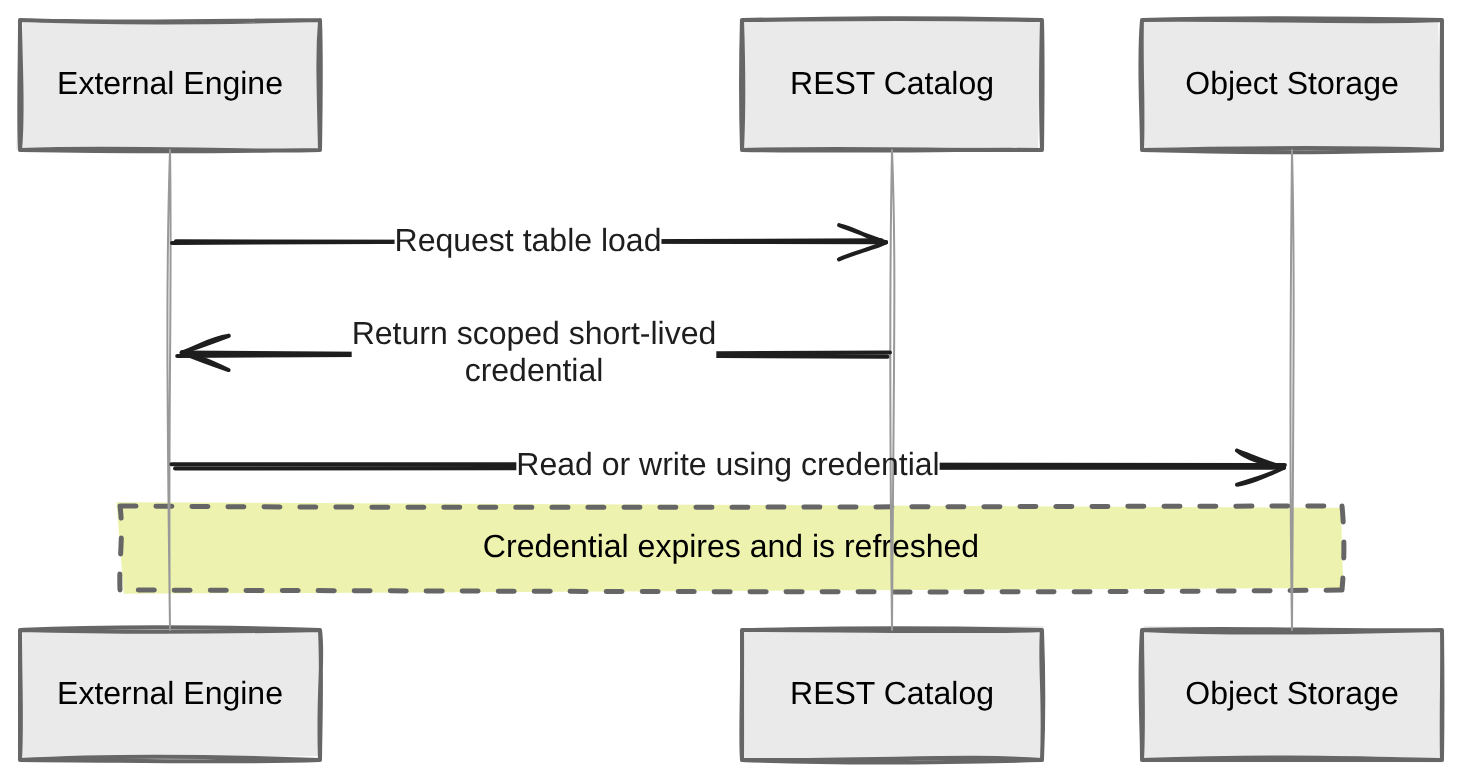
Catalog federation, not migration, is the approach that survives contact with an existing estate, because the Hive Metastore, Unity Catalog or AWS Glue Catalog a customer already runs holds access policy and lineage nobody wants to rebuild. The Apache Iceberg REST Catalog Protocol puts catalog logic behind one HTTP API so a new engine implements a client once, and it standardizes credential vending: a load-table response can return short-lived, table-scoped storage credentials instead of a long-lived cloud key, with a dedicated endpoint for refreshing them before expiry. Databricks implements the same shape on Unity Catalog, issuing temporary path or volume credentials over its own API once a principal holds the EXTERNAL USE LOCATION privilege, so an external Spark or Trino cluster gets a scoped, expiring credential instead of a static one.
curl -X POST \
  https://<workspace>/api/2.0/unity-catalog/temporary-path-credentials \
  -H "Authorization: Bearer $TOKEN" \
  -d '{"url": "s3://bucket/prefix", "operation": "PATH_READ_WRITE"}'
Snowflake supports the mirror image: a CATALOG INTEGRATION of type Apache Iceberg REST, with catalog-vended credentials as an alternative to a Snowflake-managed external volume. What the base REST spec doesn’t give is fine-grained row or column security; that lives in a newer extension, and enforcement still depends on whether the engine on the other end honors it. Lineage has to flow back to the system of record too, or governance loses visibility the moment a job running on a data platform for neoclouds touches a table.
How Neo Cloud Providers Isolate Tenants
How neo cloud providers isolate tenants matters more for data prep than it looks, because namespaces and resource quotas are soft limits, a determined job can still starve its neighbors on the same node. Dedicated node pools are a harder boundary. Microsoft’s own AKS guidance recommends a dedicated GPU node pool, tainted so only GPU-tolerant pods land there, specifically because GPU nodes are too expensive to let non-GPU work sit idle on them; the exact taint key and value are a cluster-specific convention, not a fixed string, so treat the snippet below as the pattern rather than a literal copy:
# illustrative taint/toleration pattern; exact key/value is a cluster convention
apiVersion: v1
kind: Node
metadata: {labels: {pool: gpu}}
spec:
  taints:
    - key: nvidia.com/gpu
      value: "present"
      effect: NoSchedule
# workload pod must add a matching toleration + nodeSelector: pool: gpu
Shuffle-heavy Spark jobs are noisy neighbors in a way CPU and memory quotas don’t catch: a wide shuffle saturating local disk or the NIC degrades everyone else on the node even inside a tidy cgroup. Limiting local disk throughput and network bandwidth per tenant, not just CPU and memory, is what actually contains that. Data isolation needs per-tenant keys, storage prefixes and job-scoped credentials, and one tenant’s crash should be invisible to another tenant’s job.
Ingest and Egress From the Hyperscaler
Ingest and egress from the hyperscaler where the data already lives is a recurring decision, not a one-time integration job. A one-time copy is simpler to build but goes stale the moment the source table changes again, so most pipelines need a recurring refresh, and the cheapest version of that reads incrementally from table snapshot history rather than rescanning everything. Processing close to where the data lands avoids paying egress twice, once to move it in, once to move the output back. Hyperscalers charge data transfer out per gigabyte on their own pricing pages, and whichever copy of a table is authoritative needs to be recorded somewhere a downstream job can check, or a cleaned table and a stale copy end up looking equally current.
Scheduling Data Prep Alongside GPU Training
Scheduling data prep alongside GPU training works best when the two run in separate resource pools by default, one decision that avoids most contention before it starts. Slurm’s own scheduling docs define backfill as starting lower-priority jobs only when doing so will not delay the expected start time of any higher-priority job already waiting, tuned through bf_interval, bf_max_job_start, bf_resolution and bf_window.
# slurm.conf: backfill idle nodes for low-priority data-prep work
SchedulerType=sched/backfill
SchedulerParameters=bf_interval=60,bf_max_job_start=20,bf_resolution=600,bf_window=11000
PreemptMode=SUSPEND
PreemptType=preempt/partition_prio
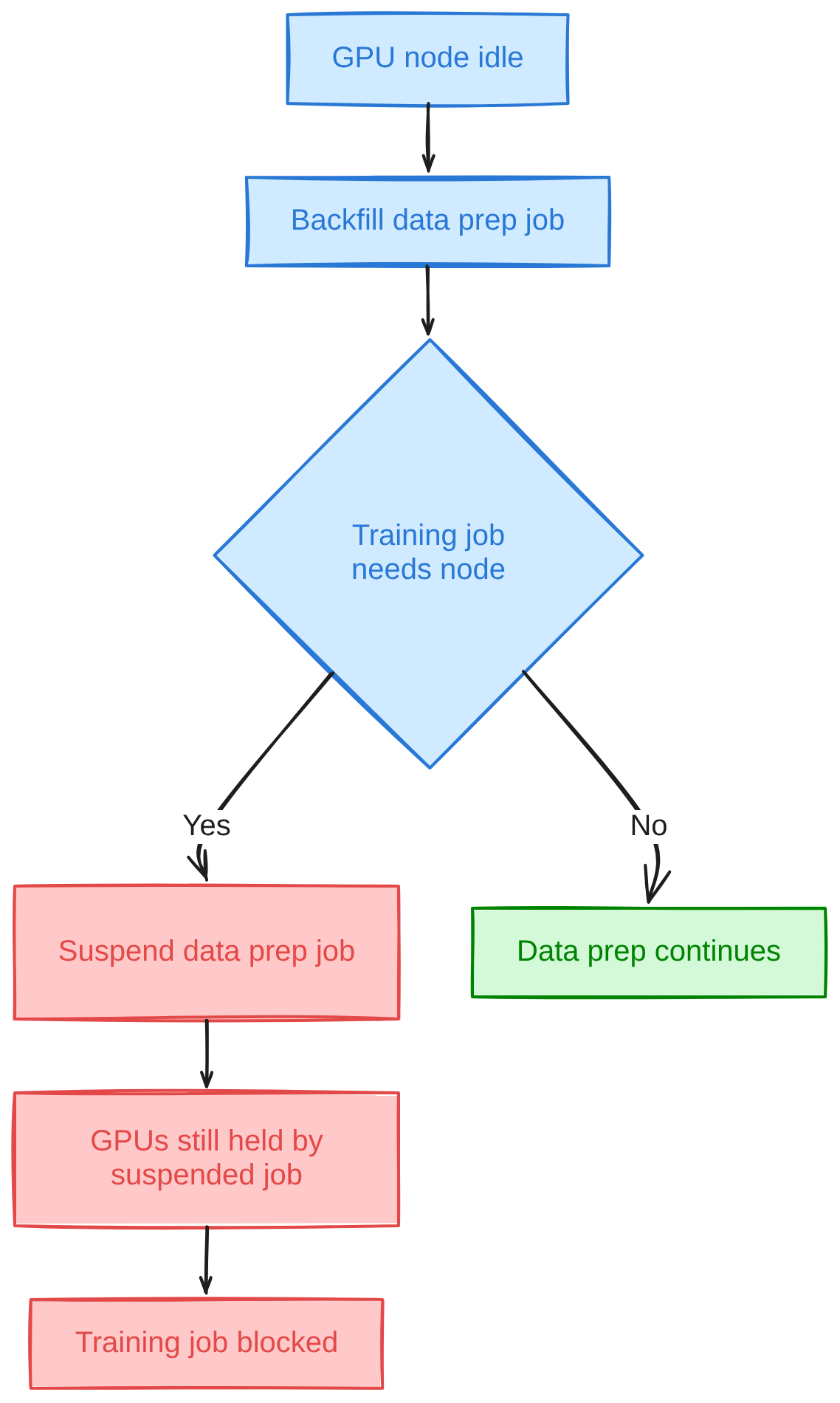
# Note: suspended jobs do NOT release GRES (GPUs) — plan accordingly
A suspended low-priority job keeps holding its GPUs, so backfilling onto idle GPU capacity without releasing GRES can block the training job it was meant to make room for. Making Spark’s own preemption cheap matters just as much. Graceful executor decommissioning plus an external shuffle service mean a reclaimed executor doesn’t force a stage restart, so the data-prep job can afford to be the one that yields.
Pricing Models and Certifications
Pricing model fit shapes a data platform for neoclouds as much as any technical decision, because the available models reward different behavior. Most managed data services meter consumption, per core-hour, per instance-hour or per proprietary compute unit, often with a management fee on top of the raw infrastructure. Per-core-hour metering invites line-by-line comparison shopping and rewards whichever engine finishes slowest, since a slow job still bills for every hour it occupies. A neocloud building or buying its own layer has to decide whether to copy that consumption model, easy to audit but punishing on long jobs, or bundle usage into a reserved contract, a per-tenant allotment, or a flat fee that doesn’t meter per core, hour or job at all.
Certifications are what buyers ask for on day one, not an afterthought: SOC 2, ISO 27001, HIPAA and GDPR coverage, audit logging, customer-managed encryption keys and data-residency controls. Treat that list as what the platform must be able to show a procurement team before the first data-processing contract, and verify any provider’s own posture in its current trust documentation rather than assuming it.
Build, Partner or Embed
Build, partner or embed is the final decision, and in practice it gets made job by job rather than once for the whole platform.
1. Build in-house
A first-party Spark service is a real, ongoing commitment: scheduler integration, catalog federation, multi-tenant isolation, certifications and support for every Spark version customers bring, maintained indefinitely. It gives full control over the stack and the roadmap, and it also makes the operator the vendor of record for a data engine, a different business from renting GPUs.
2. Partner with a managed service
EMR, Dataproc and Microsoft Fabric each wrap a control plane around open-source engines and bill for it; each is a service that runs on its own hyperscaler’s infrastructure, so partnering this way still means running on AWS, Google Cloud or Azure rather than on neocloud GPU capacity.
3. Embed an execution layer
An embedded engine installs inside infrastructure that already exists and runs specific jobs against it, without a catalog migration first.
| Need | Fits best |
|---|---|
| BI dashboards and ad hoc analyst SQL | An existing warehouse (Databricks, Snowflake), left in place |
| Federated queries across sources nobody wants to move | Starburst |
| Managed Spark/ETL without building a control plane | EMR, Dataproc |
| Run specific existing Spark jobs without migrating the catalog | An embedded execution layer |
| Full control over the stack, willing to staff it indefinitely | Build in-house |
Where Yeedu Fits as an Embedded Execution Layer
Yeedu is one example of the embed option: a re-engineered Spark execution layer with a three-tier architecture that runs inside the customer’s own environment, on AWS, Azure, GCP, Oracle Cloud or on-premises servers, across ARM, x86 and GPU runtimes. It supports multi-tenant execution, and its BYOCatalog layer reads Hive Metastore, Unity Catalog and AWS Glue in place with no metadata duplication, so governance stays with the system that already owns it. Yeedu’s Turbo engine reports 4-10x faster execution on CPU-bound Spark workloads, the joins, aggregations and multi-stage transforms the vendor puts at 30-40% of a typical mix, while multi-threaded execution, Smart Scheduling, job multiplexing and caching raise efficiency across other job shapes. Licensing is fixed-price with unlimited usage, with no per-core, per-hour or per-job charge, and Yeedu carries ISO 27001, HIPAA, GDPR and SOC 2. Adoption is job by job: specific Spark jobs point at it while the catalog, notebooks and orchestration stay where they are. This is an example of the architecture only; nothing here says Yeedu runs on any neocloud, and no neocloud partnership exists.
Conclusion
None of these decisions resolve themselves by picking a vendor; each has to be made against the fleet the platform will run on.
- Give data prep its own CPU pool; let GPU-accelerated Spark fall back to CPU automatically where it has to.
- Treat object storage in Iceberg or Delta as the system of record; local NVMe is ephemeral.
- Federate the existing catalog with vended, short-lived credentials instead of migrating it.
- Isolate tenants on local disk and network bandwidth, not just CPU and memory quotas.
- Record which copy of ingested data is authoritative before building a second pipeline against it.
- Backfill idle GPU capacity for data prep at low priority, and never preempt training to do it.
- Pick a pricing model deliberately: consumption rewards short jobs, a flat license removes the incentive to watch the clock.
FAQs
What is a data platform for neoclouds?
It’s the layer that moves raw data in, cleans and joins it, generates features and embeddings, builds eval sets and writes results back in an open table format, scoped for a fleet built around GPU training rather than general analytics. A data platform for neoclouds is not a BI tool or a second warehouse; it sits underneath both.
Do neo cloud providers offer data processing services today?
Not as a general rule. Published neocloud catalogs center on GPU compute, storage, networking and orchestration, and stop short of a managed data-processing engine. Teams today use hyperscaler-managed Spark services or embedded execution layers, Yeedu among them, that run inside their existing cloud accounts.
Should data preparation run on GPU nodes or CPU nodes?
CPU nodes, by default, because the CPUs attached to a GPU training node are already busy feeding that GPU. A separate CPU pool in the same region and storage network handles data prep without competing for cycles, and GPU-accelerated Spark can take the CPU-bound share of that work when it genuinely benefits.
How does GPU cloud computing change data platform design?
It inverts the usual assumption that CPU and memory are cheap and plentiful next to storage. On a fleet built around training GPUs, CPU cores are a scarce resource reserved for feeding them, so a data platform has to request its own CPU capacity explicitly rather than assume it’s free on the same node.
Which catalog should a neocloud data platform use?
Whichever one the customer already runs, Hive Metastore, Unity Catalog or AWS Glue, federated rather than migrated. The Apache Iceberg REST Catalog protocol and the credential-vending patterns from Databricks and Snowflake let an external engine read and write against that existing catalog with short-lived, scoped credentials instead of a static key.
Should a neocloud build its own data platform or embed one?
It depends on how much lifecycle a team can staff indefinitely. Building in-house means owning scheduler integration, catalog federation, certifications and support forever. Embedding an execution layer such as Yeedu avoids that build, at the cost of depending on an outside vendor’s roadmap for the execution engine itself.