
A sovereign cloud region buys jurisdiction and operational control over infrastructure: who can log into a host, which law applies, where the disk sits. It does not automatically buy sovereignty over the data itself: that is won or lost one layer up, in the data platform for sovereign cloud: the catalog, the processing engine, the key manager and the audit log that actually touch the data. A practitioner analysis of one European bank found its sovereign cloud commitment scoped to hosting infrastructure alone, and a later data-flow-mapping exercise found that roughly 30% of its data flows left the declared boundary anyway, routed through fraud-scoring APIs, identity-verification vendors and cross-border payment routing nobody had inventoried.
Closing that kind of gap is the job of the data platform for sovereign cloud: the software that decides where a Spark job actually runs, where a table’s metadata lives, and who holds the key that unlocks it. Options at that layer range from full lakehouse platforms to lighter execution layers, and each carries different consequences for residency, catalog placement and key custody.
This guide separates the two layers deliberately: the infrastructure controls that usually get marketed as “sovereign cloud,” and the data-layer decisions that determine whether that label survives contact with a real estate of jobs, catalogs and pipelines.
What Is a Sovereign Cloud?
A sovereign cloud is a cloud environment architected so that a defined set of legal, operational and technical controls over infrastructure and data stay inside a specific jurisdiction, instead of defaulting to wherever a provider’s global operations happen to sit. The term covers several dimensions that get conflated in vendor marketing but matter separately to a buyer.
Data residency
Data residency fixes where data is stored and processed, typically to a named country or economic bloc, and is usually the easiest control to verify from a region list.
Operational sovereignty
Operational sovereignty governs who can log in, operate, or support the underlying hardware and software, and whether that access is restricted to vetted or in-country personnel.
Legal jurisdiction
Legal jurisdiction determines which country’s courts and surveillance law can compel access to the infrastructure or the provider operating it, independent of where the servers physically sit.
Technical sovereignty
Technical sovereignty covers who holds the encryption keys, who controls the software stack, and whether a customer can exit without re-architecting everything they built.
Sovereign cloud solutions fall into three broad categories, each a different foundation for a data platform for sovereign cloud. Hyperscaler-operated or partner-operated offerings add controls on top of an existing public cloud: the AWS European Sovereign Cloud launches its first region in Brandenburg, Germany, backed by a stated €7.8B investment. National and regional providers build independently qualified platforms instead, such as OVHcloud, whose SNC Cloud Platform received ANSSI’s SecNumCloud qualification. On-premises or air-gapped private clouds are the third category, used where no shared infrastructure is acceptable.
What Is the Difference Between Sovereign Cloud and Traditional Cloud?
The difference between sovereign cloud and traditional cloud is narrower than the marketing implies: both run on broadly similar hardware and software stacks, but a sovereign deployment adds explicit controls, a narrower feature set, and usually a different support model.
| Dimension | Traditional cloud | Sovereign cloud |
|---|---|---|
| Data residency | Data may replicate across regions for latency or disaster recovery | Data is pinned to a declared region, such as AWS’s eusc-de-east-1 in Brandenburg |
| Operator access | Provider staff can access infrastructure globally for support | Access is restricted by design; AWS states its Nitro System gives no login path to instance memory, a claim independently affirmed by NCC Group |
| Key management | Provider-held keys by default, customer-managed keys as an add-on | Customer-held keys are frequently mandatory, enforced through mechanisms like hold-your-own-key external key stores |
| Service breadth | The provider’s full, continuously updated catalog | A narrower catalog; Microsoft’s own documentation states that sovereign control and service availability “varies by product, service, region, and configuration” |
| Support model | Global, follow-the-sun support | Vetted or in-country personnel requirements are common |
| Cost and feature lag | New capabilities ship to flagship regions first | Sovereign variants typically receive new capabilities later, if at all |
What Are the Key Components of a Sovereign Cloud Infrastructure?
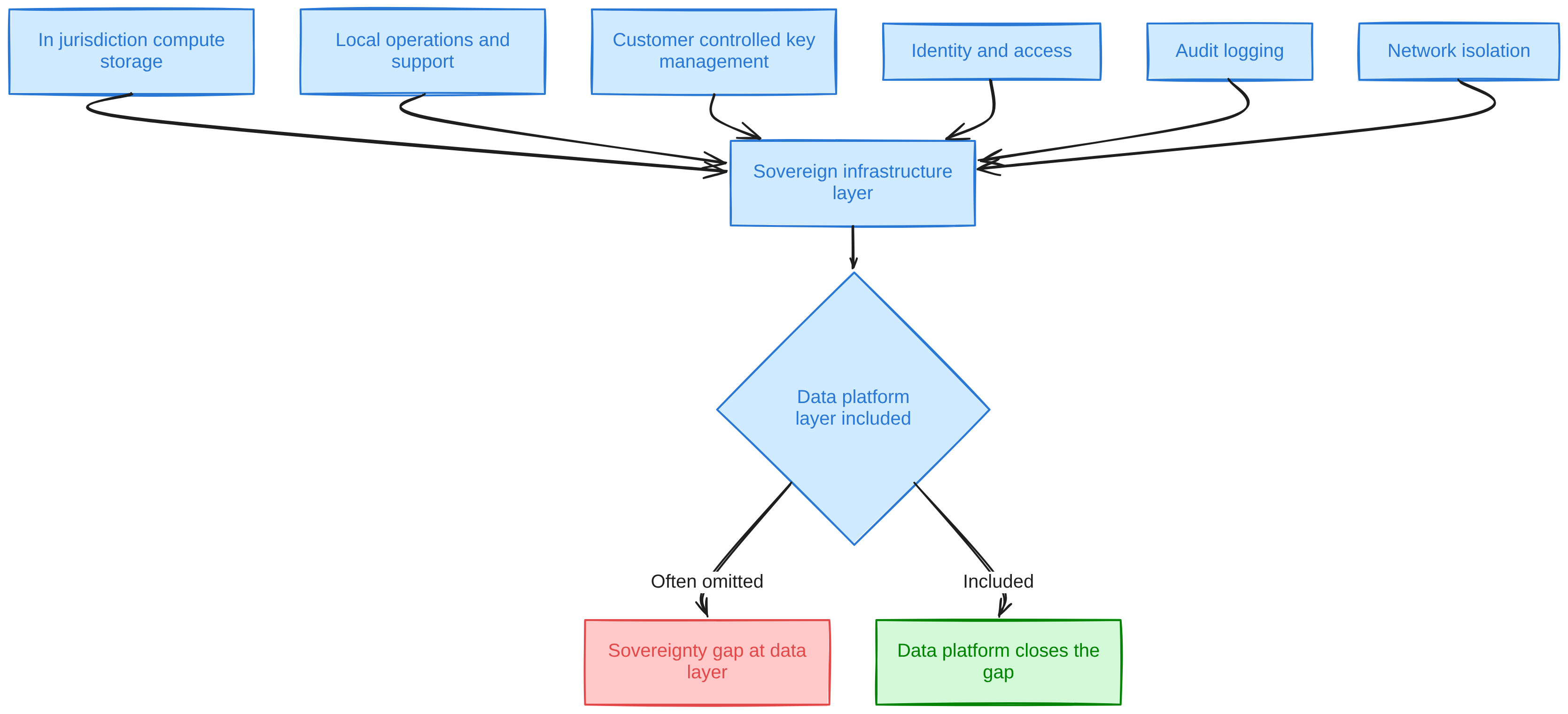
The key components of a sovereign cloud infrastructure are the building blocks that, stacked together, make a data platform for sovereign cloud deployments possible rather than theoretical. Seven of them recur across every implementation this guide reviewed.
- In-jurisdiction compute and storage: Physical or virtual resources that never leave a declared region.
- Local operations and support personnel: Staff authorized to operate and support the environment under in-country access rules.
- Customer-controlled key management: HSM-backed keys, bring-your-own-key, or hold-your-own-key (HYOK), where the provider never holds the key material. AWS KMS’s External Key Store implements HYOK by proxying every encrypt and decrypt call to a key manager the customer runs:
# AWS KMS External Key Store (XKS) proxy path rule
XksProxyUriPath must:
  - start with "/"
  - end with "/kms/xks/v1"

# KMS never stores the key; it references an existing key:
XksKeyId = <id-of-key-already-in-your-external-manager>
# All encrypt/decrypt calls are proxied to your HSM, not executed by AWS - Identity and access: Fine-grained authentication and authorization tied to the same jurisdictional boundary as the data.
- Audit logging: A continuous, tamper-evident record of who touched what, required by most national security-review regimes.
- Network isolation: Segmentation that prevents an in-boundary workload from reaching services outside the declared boundary by accident.
- The Data Platform for Sovereign Cloud: The last of these is the one most often left out of the architecture diagram. It is the layer that actually ingests, processes, catalogs and governs the data, and it is where the next section’s gap tends to open.
Why Does a Sovereign Cloud Need Its Own Data Platform?
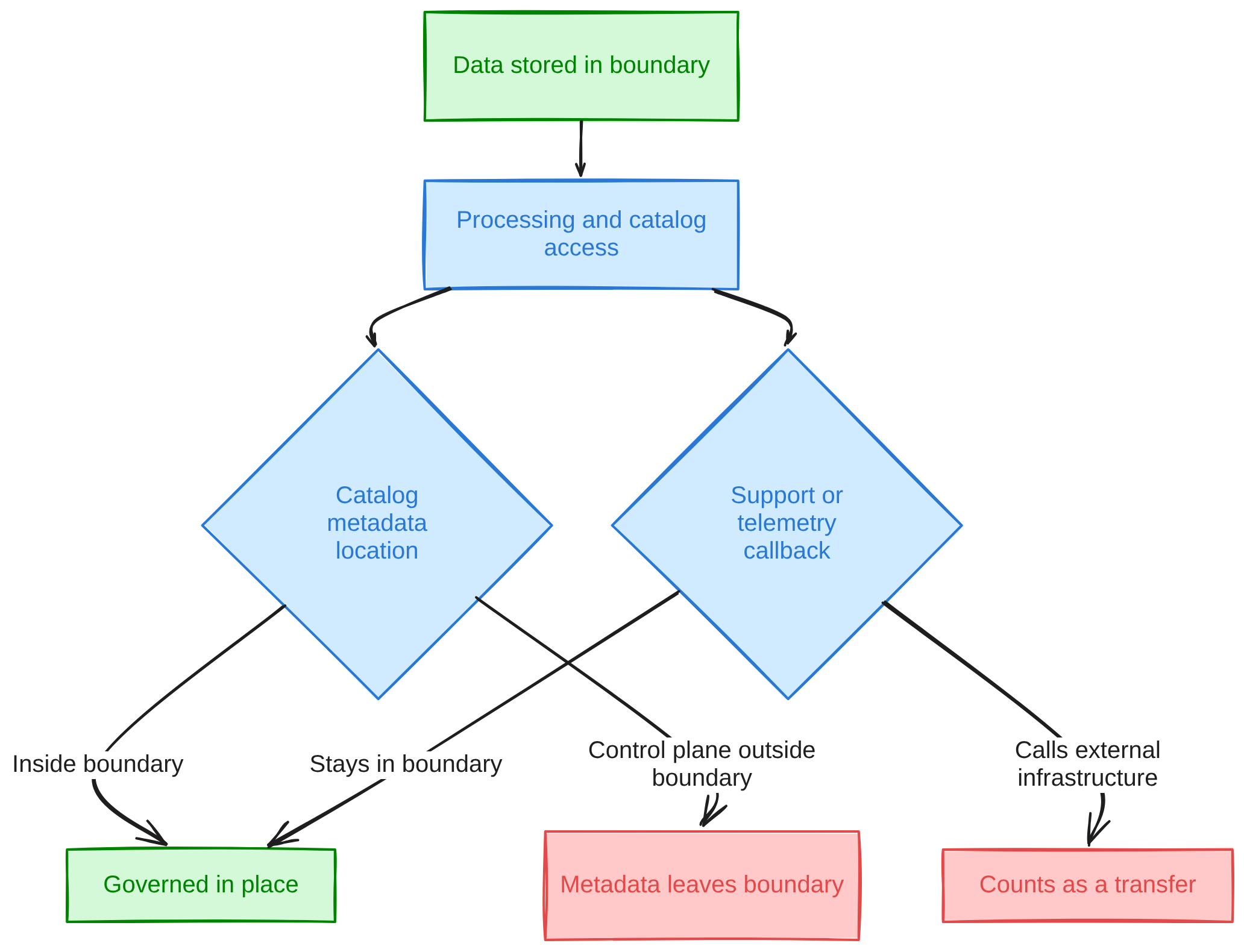
A sovereign cloud needs its own data platform because infrastructure-level sovereignty and data-level sovereignty are not the same guarantee, and a region list does not close that distance. Google’s own documentation for its France data boundary admits that Bigtable and Spanner components used inside the boundary “are accessible by Google personnel for technical support and debugging purposes, and are not subject to administrative access data controls,” which is a narrower claim than “nothing leaves the boundary.” The same page discloses that Gemini features and global Cloud Armor policies are disabled inside that boundary, one concrete case of managed data and AI tooling lagging behind the standard catalog inside a partner-operated sovereign offering, though how far that lag extends elsewhere depends on the specific provider and product.
Catalog placement raises the same problem from a different angle. Unity Catalog’s metadata lives in the Databricks control plane rather than in customer-managed storage, and a given metastore can only be used in the single region it is assigned to. Catalog metadata is itself sensitive, since it describes schemas, lineage and access policy, so it can sit outside the boundary even when the data files do not. Control planes and telemetry pipelines raise the same question Schrems II put to international transfers generally: a service that calls back to infrastructure outside the jurisdiction is a transfer, independent of where the raw data at rest physically sits. Processing, metadata, keys and logs all need to clear the same bar as storage.
How Does a Data Platform Support Data Sovereignty?
A data platform supports data sovereignty by keeping processing, catalog access, key custody and audit logging inside the same boundary as the data, instead of treating storage residency as sufficient on its own. Five mechanisms do the actual work.
Processing happens in place: jobs run against data where it already sits, rather than exporting it to a separately hosted compute service. Catalog and lineage stay inside the boundary, governed by the same identity and access controls as the data itself. Keys stay customer-managed, through HSM, BYOK or HYOK, so a provider operator is never a path to the plaintext. Every access is logged to an audit trail. Open table formats such as Apache Iceberg and Delta Lake matter here too: because the data is stored in an open, documented format rather than a proprietary one, a team can exit a given compute engine without a data migration, which keeps exit plans under measures like the EU Data Act’s switching provisions credible.
Matching a workload or team shape to an approach is usually the more useful exercise than ranking offerings in the abstract:
| Team or workload shape | Approach that typically fits |
|---|---|
| Regulated EU data already in AWS, Azure or GCP; want jurisdiction control without a new vendor relationship | A hyperscaler sovereign region or partner-operated sovereign controls layer |
| Public-sector or defense workload requiring an independently qualified provider | A national or regional provider holding a qualification such as SecNumCloud |
| Classified or air-gapped data that cannot touch shared infrastructure at all | On-premises or air-gapped private cloud |
| A handful of costly Spark jobs that must run in-boundary while the rest of the estate stays on its current catalog and orchestration | An execution layer deployed inside the existing sovereign account |
| Governance already split across Hive Metastore, Glue and Unity Catalog | Federation rather than migration between the existing catalogs |
How Does Data Governance Work in a Sovereign Cloud?
Data governance in a sovereign cloud works by classifying data, attaching residency tags and access policy to it in a catalog, and recording lineage and retention against that same catalog, so that policy travels with the data rather than living in a separate document. Classification and residency tagging happen first: a dataset gets labeled with its sensitivity and its declared jurisdiction before anything is granted access to it. Access policy, lineage and retention then get enforced from the catalog layer, which is also where audit records for who queried what get generated.
The practical question for an existing estate is whether that catalog has to be rebuilt inside the boundary or whether an existing one can be governed in place. Federation is the pattern that avoids a rebuild: Unity Catalog can register an external Hive Metastore (versions 0.13, 2.3 and 3.1 are supported) as a read-only foreign catalog without copying the underlying metadata:
-- Unity Catalog: govern an existing Hive Metastore in place
-- (additional required options omitted for brevity: user, password, db_type)
CREATE CONNECTION hms_conn TYPE HIVE_METASTORE
OPTIONS (host '<hms-host>', port '9083', user '<user>', password '<password>', db_type '<db_type>', version '3.1');

CREATE FOREIGN CATALOG fed_catalog
USING CONNECTION hms_conn
OPTIONS (database '<hms-database>');
-- Writes still go through the original Hive Metastore, not fed_catalog
AWS Glue Data Catalog does the equivalent through Lake Formation, deploying a bridging application and registering one federated database per external Hive Metastore database so permissions can be enforced centrally without a metadata copy. Who holds the keys for that governed data stays a separate question from where the catalog sits, and both answers need to be inside the boundary for the governance story to be complete.
Benefits of Enterprise Sovereign Cloud
The benefits of enterprise sovereign cloud are concentrated in regulatory exposure, trust and control rather than raw capability, and a fair accounting includes the costs too. Regulatory compliance is the most direct benefit: NIS2 (Directive (EU) 2022/2555) sets fines up to €10M or 2% of global turnover for essential entities and up to €7M or 1.4% for important ones,, and in-boundary audit logging makes compliance easier to demonstrate. Reduced exposure to extraterritorial access follows the Schrems II logic: the CJEU’s 16 July 2020 ruling invalidated the EU-US Privacy Shield over US surveillance law, and a platform whose control plane and data layer both sit inside the boundary has fewer transfers to defend. The costs are a narrower catalog, feature lag and usually a higher price.
Customer trust, control over AI training data, and resilience round out the benefit list, though none of them come with a universal figure worth quoting. The honest trade-offs sit on the other side of the ledger: a narrower service catalog, feature lag behind flagship regions, and, in most published accounts, a higher cost than the equivalent traditional-cloud footprint.
Yeedu: A Spark Execution Layer That Runs Inside Your Boundary
Yeedu is one example of an execution layer built around this model: it runs inside the customer’s own AWS, Azure, GCP, Oracle Cloud or on-premises environment, on ARM, x86 and GPU runtimes, and supports multi-tenant execution. Adoption is job by job. A Spark job is pointed at the execution layer while the catalog, notebooks, dashboards and orchestration stay where they are, and Yeedu’s BYOCatalog layer reads Hive Metastore, Unity Catalog and AWS Glue in place with no metadata duplication, so governance stays with the system that already owns it.
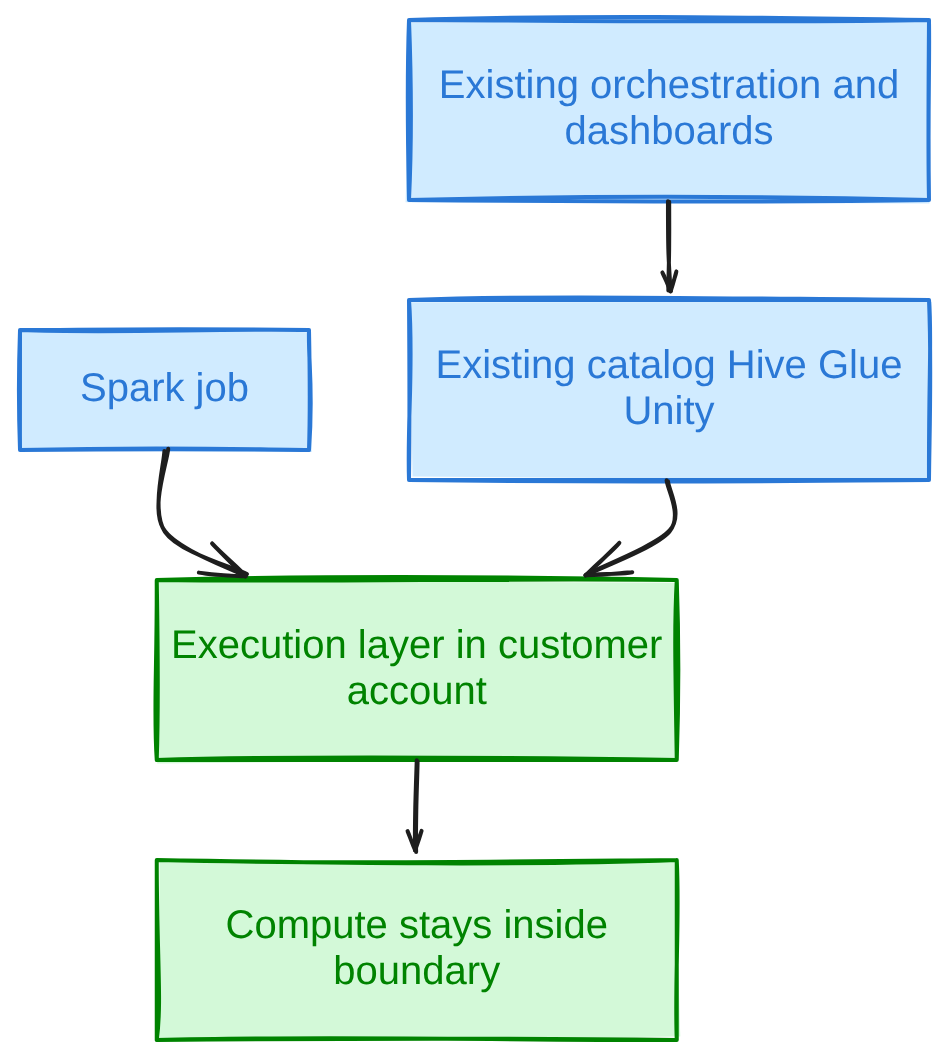
On performance and cost, Yeedu attributes a 4-10x faster execution time and 60-80% lower compute cost to its Turbo engine on CPU-bound Spark workloads, the joins, aggregations and multi-stage transforms it estimates at 30-40% of a typical mix; multi-threaded execution, job multiplexing, caching and Smart Scheduling raise efficiency on other job types too. These are vendor claims. Licensing is fixed-price with unlimited usage, with no per-core, per-hour or per-job charge, and Yeedu carries ISO 27001, HIPAA, GDPR and SOC 2. This is an example of the architecture only: nothing here says Yeedu runs on, is certified for or partners with any named sovereign cloud offering, and it is deployed in the customer’s own account or on their own servers.
Conclusion
A sovereign cloud region is a necessary control rather than a sufficient one. The sovereignty that actually matters to a regulator, an auditor or a customer is decided at the data platform layer, where processing, catalogs, keys and logs either stay inside the declared boundary or quietly do not.
- Infrastructure sovereignty covers residency, operator access and jurisdiction; it says nothing about where a job’s compute, a catalog’s metadata or a key’s material actually live.
- Sovereign cloud solutions span hyperscaler-operated regions, partner-operated controls, national providers and on-premises deployments, each with a different feature-lag and support trade-off.
- A data platform for sovereign cloud closes the gap by keeping processing, catalog access and audit logging inside the same boundary as storage.
- Federation, rather than migration, is the practical pattern for governing an existing Hive Metastore, Glue or Unity Catalog estate in place.
- Open table formats like Iceberg and Delta keep an exit plan credible rather than theoretical.
- Regulatory drivers (NIS2, the EU Data Act, Schrems II) reward architectures that can show, rather than just claim, where data and metadata sit.
- Execution-layer products that run inside a customer’s own account let individual jobs move without a wider platform migration.
FAQs
What is a data platform for sovereign cloud?
It is the software layer that ingests, processes, catalogs and governs data inside a declared sovereign boundary, as opposed to infrastructure controls that only govern residency and access. Without this layer, metadata, processing and logs can leak outside the boundary even when raw storage does not.
What are sovereign cloud solutions?
Sovereign cloud solutions fall into three categories: hyperscaler-operated or partner-operated offerings layered onto an existing public cloud, independently qualified national or regional providers, and on-premises or air-gapped private clouds. Each trades off feature breadth against the strength of its jurisdictional guarantee. The right category depends on what a specific workload’s regulator actually requires rather than on which offers the broadest catalog.
Can a hyperscaler region be a sovereign cloud?
Yes, within limits: AWS, Microsoft and Google all offer sovereign variants layered onto their standard clouds, such as the AWS European Sovereign Cloud or Microsoft’s Sovereign Public Cloud controls. These typically launch with a narrower service catalog and documented feature lag relative to flagship regions. A hyperscaler sovereign offering is a legitimate category rather than a lesser one, though it is not identical to the provider’s full platform.
Does a sovereign cloud require on-premises infrastructure?
No. On-premises and air-gapped deployment is one valid path to a sovereign architecture, but hyperscaler sovereign regions and partner-operated controls achieve comparable jurisdictional guarantees without leaving the public cloud. The right choice depends on the specific regulatory regime and the workload’s tolerance for a narrower managed-service catalog. Partner-operated offerings such as Google’s Sovereign Controls by Partners and OVHcloud’s SecNumCloud-qualified platform exist specifically to serve regulated workloads without requiring a customer to run its own data center.
How do you run Apache Spark in a sovereign cloud?
Spark can run on a managed lakehouse cluster deployed inside the sovereign region, or on an execution layer deployed inside the customer’s own account, such as Yeedu, which runs on AWS, Azure, GCP, Oracle Cloud or on-premises servers without a separate, externally hosted processing service. Either approach keeps compute inside the declared boundary, and catalog access is typically federated against the existing Hive Metastore, Unity Catalog or Glue setup rather than duplicated.
Is a sovereign cloud more expensive than a traditional cloud?
Generally yes, though the exact premium is not something the major providers publish on their own pricing pages, so any specific percentage should be treated skeptically. The added cost tends to come from dedicated infrastructure, in-country support staffing and compliance overhead rather than from the compute itself. Buyers should request a region-specific quote rather than rely on a published rate card.