✦ Register Now ✦ Take the 30 Day Cost-Savings Challenge

Mount Management in Yeedu: Attaching External Storage to Compute Clusters

Konda Samaikya
March 12, 2026
yeedu-linkedin-logo
yeedu-youtube-logo

1. Introduction

Mount Management in Yeedu enables secure attachment of external cloud storage systems to compute clusters as part of cloud storage mount management. A mount acts as a logical connection between a cluster and a storage source such as Amazon S3, Azure Blob Storage, or Google Cloud Storage.

Mounts allow clusters to read or write data from external storage in a controlled, secure way, supporting cluster storage management across distributed environments.

2. What is a Mount

What is a cloud storage mount? A mount is a configuration object that contains the following details:
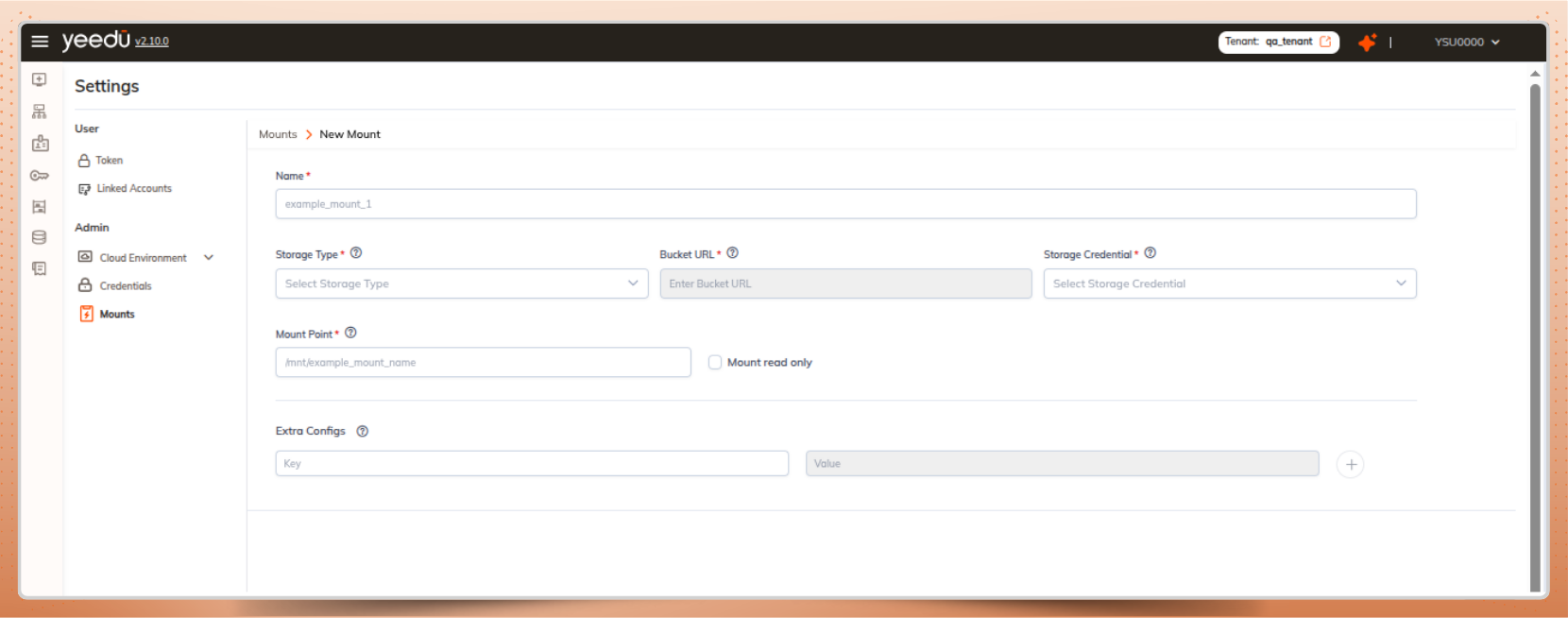
  • Mount name
  • Storage type
  • Source path such as bucket or container URL
  • Storage Credential
  • Read-only flag
create mount

3. Supported Storage Providers

Yeedu supports mounting storage from multiple cloud providers including:

  • Amazon S3
  • Azure Blob Storage
  • Google Cloud Storage

This multi cloud storage integration capability ensures flexibility and scalability across environments.

4. Core Functional Capabilities

4.1 Create Mount

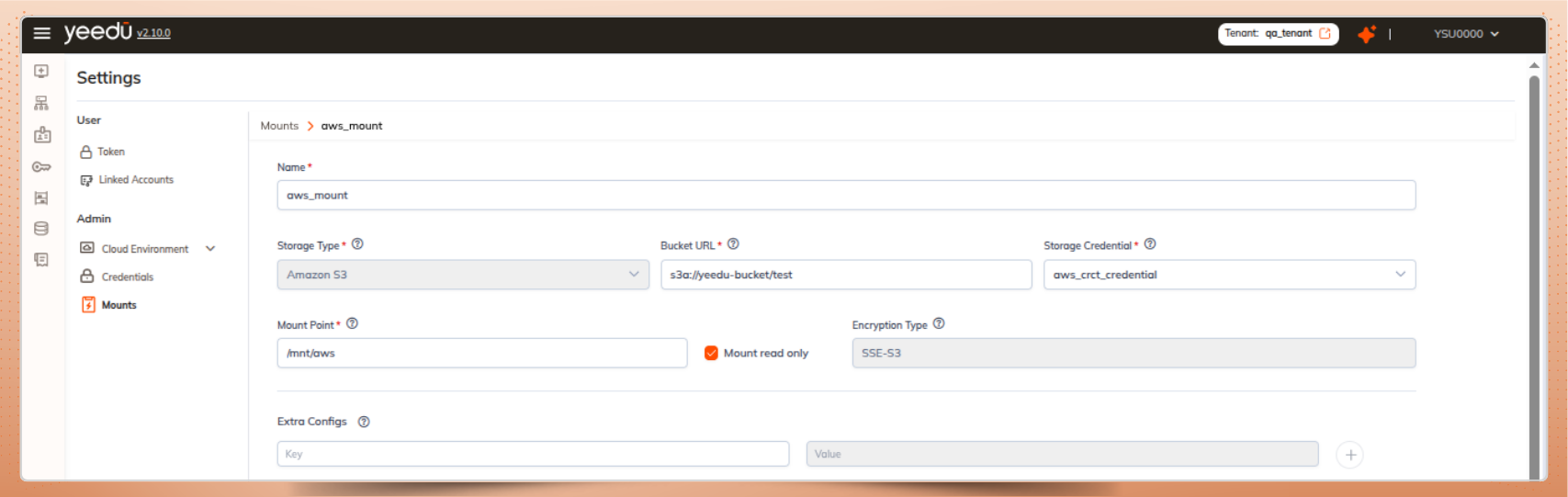
Authorized users such as Platform Admin or Admin can create a mount by providing:

  • Valid storage type
  • Valid credential configuration
  • Valid source URL
  • Unique mount name within the tenant

Validation rules include:

  • Required fields must be provided
  • Duplicate names within the same tenant are not allowed
  • Credential and encryption references must exist
  • Source URL must be correctly formatted
Filled mount page

4.2 List and Filter Mounts

Users can:

  • Retrieve all mounts with pagination
  • Filter mounts by storage type
  • Retrieve mount details by name

The system ensures correct metadata response and strict tenant-level isolation for reliable cluster storage management.

4.3 Update Mount

Mount metadata such as mount point, description, or read-only flag can be modified.

Updates maintain audit timestamps and preserve tenant ownership in the overall cloud storage mount management lifecycle.
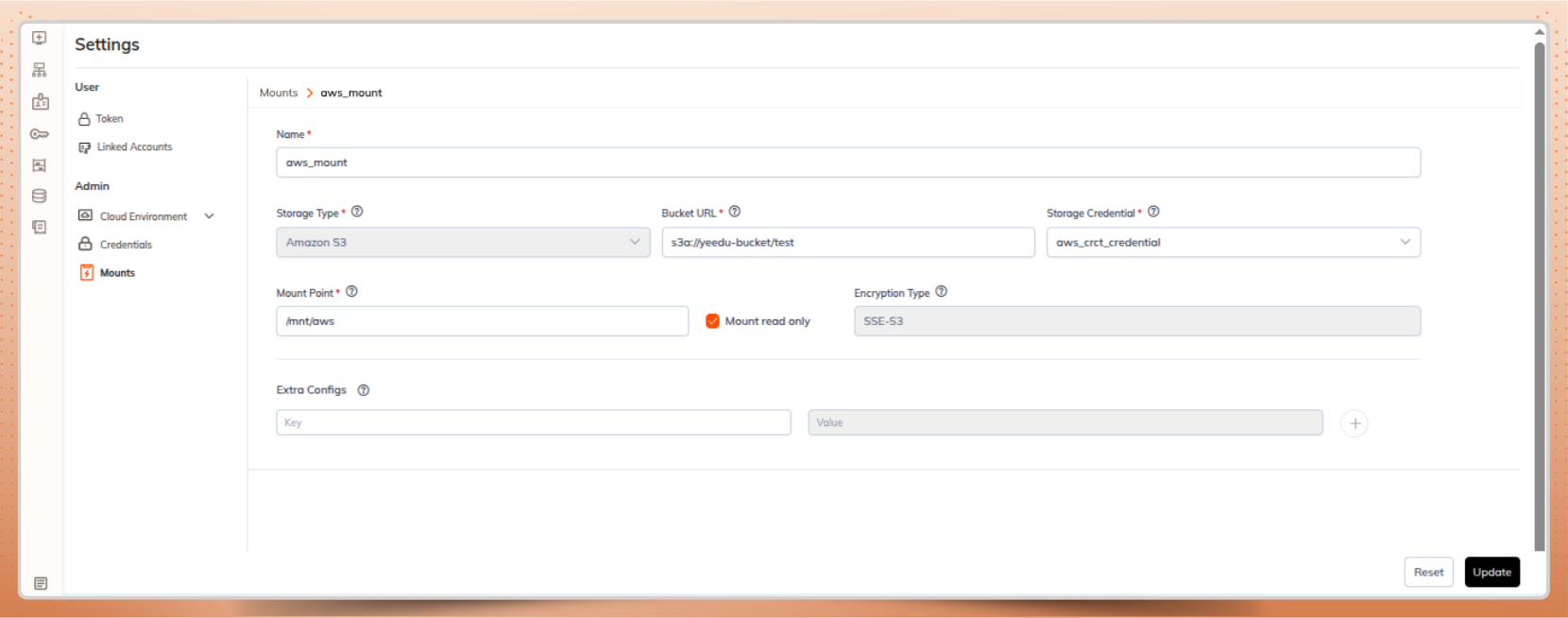
Update mount

4.4 Soft Delete Mechanism

Yeedu implements soft delete instead of permanent deletion.

When a mount is deleted:

  • TO_DATE is updated with the current timestamp
  • The mount becomes inactive
  • Historical records remain preserved
Delete mount

5. Cluster-Mount Association

Mounts must be explicitly attached to clusters before use to mount external storage to compute clusters securely.

5.1 Attach Mount

Preconditions:

  • Cluster must be in ERROR, or DESTROYED state
  • Mount must be active

On successful attachment:

  • A mapping record is created
  • The mount becomes accessible to the cluster
attach mount
attaching mount

5.2 Detach Mount

When a mount is removed from a cluster:

  • The mapping record TO_DATE is updated
  • The cluster no longer has access

Proper detachment helps maintain efficient cluster storage management.
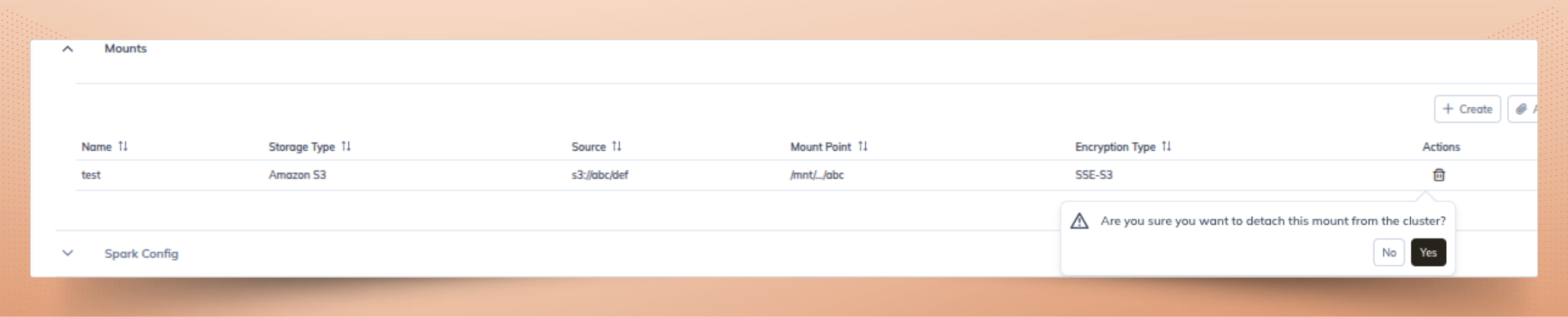
Detach mount

6. Security and Access Control

6.1 Role-Based Access Control

Platform Admin has full mount lifecycle control.

Admin can manage mounts within the tenant.

Viewer has read-only access and cannot create or delete mounts.

Unauthorized operations return a 403 Access Denied response, ensuring secure cloud storage mount management.

6.2 Tenant Isolation

Mounts are strictly tenant-scoped.

Cross-tenant operations are not allowed and return a 404 error. This ensures data segregation and multi-tenant security compliance during multi cloud storage integration.

6.3 Credential and Encryption Validation

Mounts depend on valid credential configurations and encryption type references.

Invalid credential ID or encryption reference results in 400 or 404 error responses.

This prevents insecure or broken storage connections when organizations mount external storage to compute clusters.

7. Read-Only Enforcement

If the read-only flag is set to true:

  • Write operations are blocked
  • A proper error message is returned

This mechanism supports secure cluster storage management policies.

8. Error Handling and Validation

The system properly handles the following scenarios:

  • Missing required fields returns 400
  • Duplicate mount names returns 409
  • Invalid credential reference returns 400 or 404
  • Attaching mount to a running cluster returns 400
  • Deleting non-existent mount returns 404
  • Unauthorized access returns 403
  • Invalid source URL returns 400
  • Cross-tenant attach attempts return 404

9. Lifecycle and Audit Tracking

Each mount follows a lifecycle:

  1. Created and active
  2. Updated
  3. Attached or detached
  4. Soft deleted and inactive

Lifecycle tracking ensures reliable cloud storage mount management and operational accountability.

10. Architectural Highlights

  • Multi-cloud compatibility – Mount Management in Yeedu supports seamless integration across multiple cloud providers, enabling multi cloud storage integration and consistent behavior across environments.
  • Strict tenant isolation – Each tenant’s storage mounts are logically and securely isolated to prevent cross-tenant data access and maintain strong security boundaries.
  • Secure credential abstraction – Sensitive credentials are abstracted and managed securely through encrypted secrets, preventing direct exposure in jobs or cluster configurations.
  • Lifecycle enforcement – Mounts follow defined lifecycle policies, ensuring proper creation, validation, usage, and controlled decommissioning.
  • Cluster state validation – The system validates cluster readiness and state before mount operations to avoid runtime failures and ensure operational stability.
  • Read-only governance – Supports read-only mount configurations to enforce data protection policies and prevent unintended modifications.
  • Soft deletion for compliance – Instead of permanent removal, mounts are soft-deleted to maintain audit trails and meet compliance requirements while allowing controlled recovery and supporting Cloud cost optimization by avoiding unnecessary storage reconfiguration.

Conclusion

Mount Management in Yeedu is a secure, lifecycle-driven, tenant-isolated system designed to safely connect clusters with external cloud storage.

Through strong validation, role-based access control, multi-cloud support, soft deletion, and cluster state enforcement, Yeedu ensures that storage integration remains secure, auditable, and production-ready for modern cluster storage management environments.

Mounts are critical components that maintain data security, tenant isolation, and cloud interoperability across the platform while enabling organizations to mount external storage to compute clusters efficiently.

Join our Insider Circle
Get exclusive content crafted for engineers, architects, and data leaders building the next generation of platforms.
Thank you! Your submission has been received!
Oops! Something went wrong while submitting the form.
No spam. Just high-value intel.
Back to Resources